EN
EN
Rat Dorsal Root Ganglion Neuron Cells
Introduction
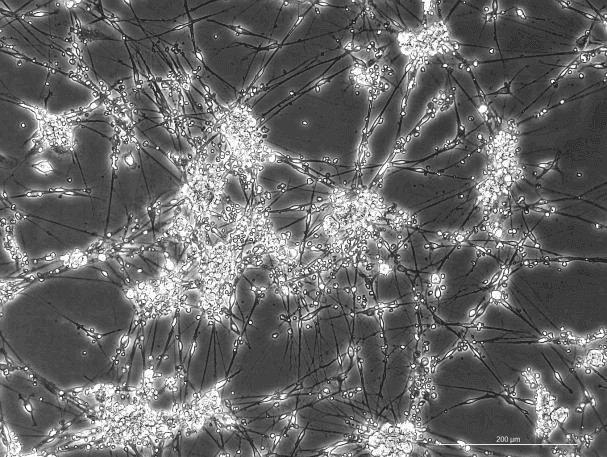
Rat dorsal root ganglion (DRG) neurons are isolated from spinal dorsal root ganglia. Sensory neuroblasts extend axons in bundled formations that enter the dorsal aspect of the neural tube bilaterally. At this stage, the spinal ganglia are referred to as dorsal root ganglia (DRG). Neurons, the fundamental structural and functional units of the nervous system, vary greatly in size and morphology within the central nervous system. However, they universally possess a cell body (soma), dendrites, and an axon.
The cell body, also known as the perikaryon, contains neurofilaments, microtubules, endoplasmic reticulum, free ribosomes, and a nucleus with a prominent nucleolus. Dendrites and axons are neuronal processes responsible for transmitting electrical impulses between neurons. These processes vary in size and morphology, making it difficult to distinguish them clearly under conventional light microscopy.
The spinal dorsal root ganglion is a major component of the peripheral nervous system and serves as a primary relay station for sensory signal transmission. The isolation of DRG neurons is a technically demanding procedure, requiring the rapid dissection of dorsal root ganglion tissue under a stereomicroscope to obtain sufficient viable material within a limited time window.
OriCell™ Rat Dorsal Root Ganglion Neuron Cells are derived from Sprague-Dawley (SD) rats. They provide a valuable in vitro model for neuroscience research, including studies of peripheral nervous system myelination, neurotrophic factor function and receptor distribution, neuronal aging, gene therapy, and tissue engineering.
When citing our products in academic publications, please use the following format: "OriCell™ [Product Name] + [Catalog Number], from Cyagen Biosciences."
Product Information
| Product Name | OriCell™ Rat Dorsal Root Ganglion Neuron Cells |
| Catalog Number | SDDRG-00001 |
| Amount of Cells | 1×10⁶ cells/vial |
| Passage Number | P0 |
| Storage at | Liquid Nitrogen (-196 ℃) |
QC
- Pass the detection of bacteria, fungi, mycoplasma, and endotoxins.
- Verified by cell recovery testing, with a post-thaw viability of > 50%.
- Verified by flow cytometry: Positive for β-tubulin III (> 70%).
Please refer to "COA" for details.
General Handling Principles
- Maintain strict aseptic technique. Ensure complete sterility throughout all procedures, particularly within the laminar flow hood and incubator.
- Follow standardized protocols. Adhere strictly to the product manual. Implement rigorous control over experimental variables and include appropriate parallel controls.
- Use high-quality consumables and reagents. This product requires culture vessels suitable for adherent growth, and the reuse of these vessels is not recommended. The reagents used must be validated for reliability, cell compatibility, and batch-to-batch consistency.
- Optimize seeding density and subculture. The recommended seeding density for OriCell™ Rat Dorsal Root Ganglion Neuron Cells is (2–3) × 105 live cells/cm². Since cell growth is highly dependent on donor characteristics and culture conditions, we recommend adjusting the split ratios based on the actual performance of each specific lot and passage.
Warm Notice: The cryopreservation medium of this product contains DMSO, which has potential risks. Please handle it carefully.