EN
EN
MDCK Canine Kidney Cell Line
Introduction
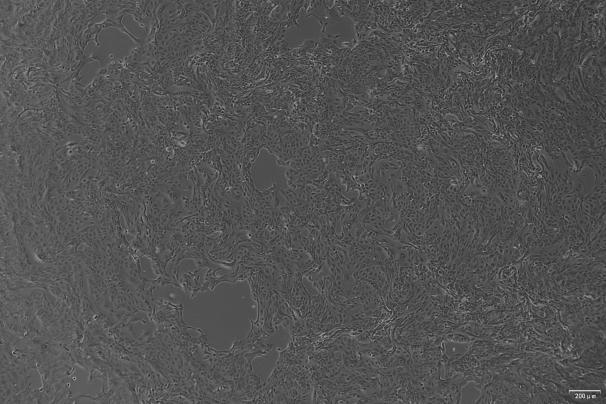
The MDCK (Madin-Darby Canine Kidney) cell line was successfully isolated in September 1958 by Madin SH and Darby NB from the normal kidney tissue of an adult female Cocker Spaniel. The cells exhibit a characteristic epithelial-like morphology and grow adherently. Their karyotype is hyperdiploid with a bimodal chromosome distribution. While consistent marker chromosomes are absent, a normal X chromosome is maintained in the majority of cells. Immunoperoxidase staining has demonstrated that MDCK cells are positive for cytokeratin, further confirming their typical epithelial characteristics.
MDCK cells possess the remarkable ability to form highly polarized monolayers in vitro, characterized by distinct apical-basolateral differentiation and well-developed tight junction structures. Therefore, they are a classical model for investigating epithelial cell polarity, transmembrane transport, protein sorting, and the physiological/pathological mechanisms of renal epithelial cells.
In addition, MDCK cells are highly susceptible to a broad range of influenza viruses (including types A and B) and support robust viral replication. This makes them one of the most widely used cell lines for viral culture, isolation, amplification, and titration assays. In the biopharmaceutical field, MDCK cells are also extensively employed as a key cell substrate for influenza vaccine production.
OriCell™ MDCK Canine Kidney Cell Line has undergone rigorous validation to ensure superior adherence and stable proliferation across passages. Beyond its consistent morphology, this cell line is characterized by a rapid doubling time and robust genetic integrity throughout extended culture. Most importantly, it maintains high viral susceptibility, making it an ideal host for demanding viral amplification and high-throughput antiviral screening. Our stringent quality control—guaranteed free from mycoplasma, bacteria, and fungi—ensures exceptional reproducibility and data integrity for your research.
When citing our products in academic publications, please use the following format: "OriCell™ [Product Name] + [Catalog Number], from Cyagen Biosciences."
Product Information
| Product Name | OriCell™ MDCK Canine Kidney Cell Line |
| Alternative Names | MDCK; MDCK (NBL-2); MDCK(NBL-2); NBL-2; Madin-Darby Canine Kidney; Madin Darby Canine Kidney |
| Catalog Number | D4-0401 |
| Amount of Cells | 1×10⁶ cells/vial |
| Tissue Origin | Canine Kidney |
| Cell Characteristics | Adherent Growth; Epithelial-like |
| Culture Conditions | 95% air; 5% CO2; 37 ℃ |
| Culture Medium | DMEM + 10% FBS |
| Doubling Time | 12 ~ 24 h |
| Biosafety Level | 1 |
| Storage at | Liquid Nitrogen (-196 ℃) |
| Precautions | —— |
QC
- Pass the detection of bacteria, fungi, mycoplasma, and endotoxins.
- Verified by cell recovery viability testing.
- Verified by STR analysis.
Please refer to "COA" for details.
General Handling Principles
- Maintain strict aseptic technique. Ensure complete sterility throughout all procedures, particularly within the laminar flow hood and incubator.
- Follow standardized protocols. Adhere strictly to the product manual. Implement rigorous control over experimental variables and include appropriate parallel controls.
- Use high-quality consumables and reagents. This product requires culture vessels suitable for adherent cell growth, and the reuse of these vessels is not recommended. The reagents used must be validated for reliability, cell compatibility, and batch-to-batch consistency.
Warm Notice: The cryopreservation medium of this product contains DMSO, which may pose potential risks. Please handle it with care.