
 EN
EN
MSC Chondrogenic Differentiation Troubleshooting: Why Do Cartilage Pellets Dissociate and How to Prevent It?
Introduction
During MSC chondrogenic differentiation, three-dimensional cartilage pellet formation is widely used to evaluate the chondrogenic potential of MSCs. However, pellet dissociation or poor aggregation is a common challenge that can affect downstream analysis.
In this article, we summarize the major causes of cartilage pellet disruption and provide practical solutions to improve pellet stability during MSC chondrogenic induction.
Why Do Cartilage Pellets Dissociate During MSC Chondrogenic Differentiation?
During MSC chondrogenic differentiation, cartilage pellet formation relies on stable cell aggregation and extracellular matrix deposition. Pellet dissociation may occur when the aggregation process is disrupted or when the developing cartilage structure is exposed to excessive mechanical stress.
Common Mistakes That Affect Cartilage Pellet Formation
| Common Mistake | Why It Affects Pellet Formation |
|---|---|
| Incorrect Cell Seeding Density | If the cell number does not follow the recommended range, either too many or too few cells can interfere with proper pellet formation. |
| Excessive Mechanical Stress During Medium Changes | Directly flushing the cartilage pellet with the pipette tip may disrupt cell–cell connections and the developing extracellular matrix. |
| Unsuitable Culture Conditions | Using standard adherent plates or tubes may cause cells to attach to the surface, leading to tearing or disruption of the cell micromass. |
| Disturbance During Early Pellet Formation | Frequent movement or shaking within the first 24–48 h before stable pellet formation can prevent cells from forming a compact aggregate. |
| Improper Centrifugation Conditions | Insufficient centrifugation force or time may result in a loose pellet, while excessive force may damage cells and increase the risk of later pellet dissociation. |
Understanding these factors can help researchers identify potential problems during chondrogenic induction and improve the consistency of MSC cartilage pellet formation.
Can Dissociated Cartilage Pellets Be Recovered?
If pellets dissociate during the early stage, they may still consist mainly of loosely aggregated cells with limited matrix deposition. In cases of mild dissociation, they may be able to reaggregate into pellets.
If pellets dissociate during the middle or late stage of induction, they are difficult to reaggregate and are generally no longer recoverable. In this case, restarting the chondrogenic induction workflow is recommended.
Best Practices for Successful MSC Chondrogenic Pellet Formation
1. Cell Preparation
Use low-passage MSCs that are in the logarithmic growth phase and have viability ≥95%.
2. Reagent Preparation
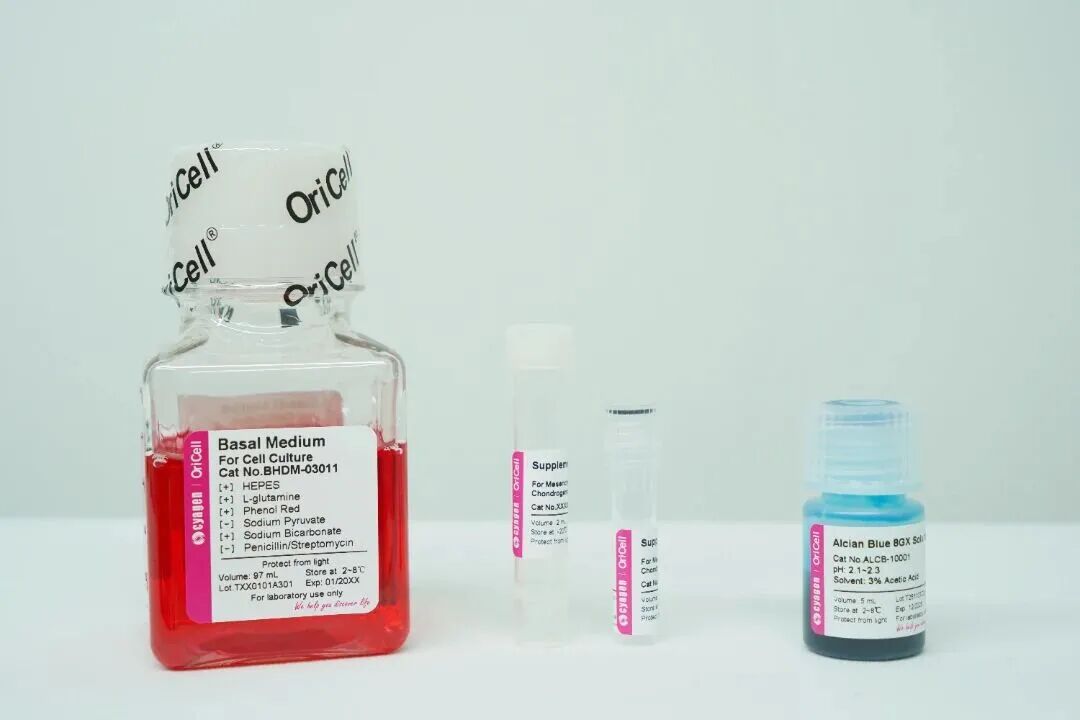
OriCell Chondrogenic Differentiation Medium For Human Umbilical Cord Mesenchymal Stem Cells (Cat. No. HUXUC-90041) is a serum-free culture system customized for inducing cells from specific species and tissue sources. Chondrogenic induction should be performed in 15 mL conical-bottom centrifuge tubes.
Key Steps for Chondrogenic Induction
The chondrogenic induction kit contains basal medium, chondrogenic differentiation supplements, and Alcian Blue staining solution, with a total volume of 100 mL/kit.
Pellet Formation Procedure: Gold Standard
- • Seed 3–4 × 10⁵ cells per tube/well.
- • After resuspending the cells in chondrogenic induction medium, centrifuge at 200 × g for 4 min to form a compact cell pellet. Do not pipette the pellet.
- • Loosen the centrifuge tube cap and incubate the tube upright for 24 h without moving it. After a compact microsphere forms spontaneously, gently tap the tube to suspend the pellet. Before each medium change, gently lift the cell pellet to ensure sufficient contact with the induction medium.
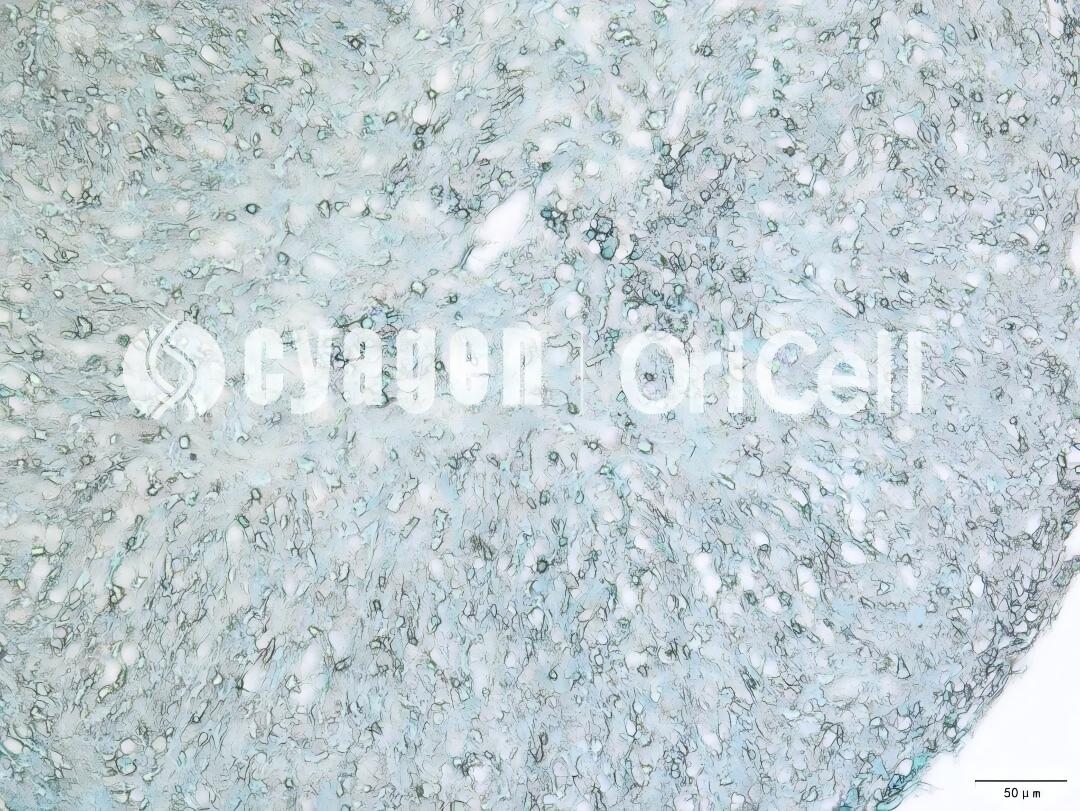
- • Terminate induction when the cell pellet diameter increases to approximately 1.5–2 mm, then proceed with downstream paraffin sectioning and Alcian Blue staining for identification.
Medium Change Procedure
Change the medium every 2–3 days. When aspirating medium, keep the pipette tip against the tube wall and operate slowly just below the liquid surface. Avoid touching the cartilage pellet.
Medium Addition Procedure
Slowly add fresh induction medium prewarmed to 37°C along the tube wall, using gentle handling throughout the process.
Medium Quality Control
The induction medium should be prepared fresh before use and should not be subjected to repeated freeze–thaw cycles.
Stable Culture Environment
Maintain the culture at 37°C, 5% CO₂, and saturated humidity. Avoid frequent opening and closing of the incubator door, as this may cause fluctuations in temperature and CO₂ levels.
Experimental FAQ
Q: Can cartilage pellets that have already dissociated be recovered?
A: It depends on the induction stage. Early-stage pellets with limited matrix deposition may reaggregate if dissociation is mild. Mid- to late-stage pellets are usually difficult to recover, and restarting the chondrogenic induction workflow is recommended.
Q: Why is the recommended cell number important for pellet formation?
A: Proper pellet formation depends on a suitable cell density. Too few cells may fail to establish stable aggregation, while too many cells may compromise uniform pellet formation and nutrient exchange.
Q: Why should the pellet not be pipetted after centrifugation?
A: After centrifugation, the cell pellet is still forming. Pipetting can disrupt early cell–cell aggregation and prevent the development of a compact cartilage pellet.
Q: Why should the tube remain undisturbed during the first 24 h?
A: The first 24 h is critical for spontaneous formation of a compact microsphere. Moving or shaking the tube too early may prevent stable aggregation and increase the risk of pellet dissociation.
Q: Why should the pellet be gently lifted before medium changes?
A: Gently lifting the cell pellet helps ensure adequate contact between the pellet and the induction medium, supporting more consistent chondrogenic differentiation.
Q: Why should the centrifuge tube cap be loosened before placing the tube in the incubator?
A: After medium replacement, the centrifuge tube cap must be loosened before incubation to maintain appropriate gas exchange under 37°C and 5% CO₂ culture conditions.
Q: How can mechanical disruption during medium changes be avoided?
A: Keep the pipette tip against the tube wall, aspirate slowly just below the liquid surface, and avoid direct contact with the cartilage pellet.
Q: Why should freshly prepared induction medium be used?
A: Freshly prepared induction medium helps maintain reagent activity and consistency. Repeated freeze–thaw cycles may compromise medium performance and affect differentiation outcomes.
Recommended MSC Chondrogenic Differentiation Solutions
To improve the consistency of MSC chondrogenic differentiation experiments, OriCell provides optimized chondrogenic induction media designed for different MSC sources, supporting stable cartilage pellet formation and downstream differentiation analysis.
OriCell Featured Products
About Cyagen OriCell
Cyagen OriCell is a Cyagen brand focused on the research and development of cell biology products, including stem cells, primary cells, and cell lines, as well as cell culture reagents and technical services. Serving universities, research institutes, hospitals, CROs, and CDMOs worldwide, Cyagen OriCell has accumulated extensive expertise in cell isolation and culture. The team has developed "spatial replication" culture technology to rapidly establish growth‑supportive environments, and runs an Antibiotic‑Free process grounded in strict environmental, materials, and personnel controls. Cyagen OriCell provides end‑to‑end solutions—from MSC isolation and identification to directed differentiation and assay services.
Cyagen OriCell's offerings are cited in over 10,000 publications, with a cumulative impact factor exceeding 90,000 and more than 160,000 citations, and the team has supported more than 3,000 research groups. Products are used by tens of thousands of customers across dozens of countries and regions.

