
 EN
EN
DMSO, the Classic and Practical Cryoprotectant — Chances Are You've Used It
Dimethyl sulfoxide (DMSO) is familiar to many researchers, and reagent vendors often flag products that contain it. What does DMSO do in cell culture, and why do we rely on it yet remain cautious? This article reviews DMSO's properties, cryoprotective use, toxicity considerations, mitigation strategies, thawing practice, and related OriCell products.
DMSO: A Brick That Fits Wherever Needed
Physical Properties of DMSO
At room temperature, DMSO is a colorless, odorless, transparent liquid with strong hygroscopicity and is flammable. Its relative density is 1.095–1.105 g/mL [1].
Chemical Properties of DMSO
Molecular formula C2H6OS; structural formula (CH3)2SO. DMSO dissolves most water‑soluble and lipid‑soluble compounds, often dubbed a “universal solvent”.

Applications Across Sectors
Discovered in the 1950s and widely used since, DMSO is among the most widely used sulfoxides. Depending on application, DMSO can be graded for topical pharmaceutical use, industrial use, medicinal use, reagent use, electronics use, etc. Typical uses include pharmaceutical synthesis solvent, pesticide solvent, dye/pigment solvent, petroleum extraction solvent, rust inhibitor, polymer processing/impregnation, synthetic resin polymerization solvent, hydrothermal synthesis solvent, cryoprotectant, and transdermal penetration enhancer. China is a major producer and exporter of DMSO, with broad growth prospects.
DMSO and Toxicity: Evidence‑Based View
DMSO is widely used in labs, and discussions often invoke “toxicity”. Its cellular and patient toxicity profile remains under active investigation. In vitro cryopreservation reduces cellular metabolism at low temperatures for long‑term storage. Without cryoprotectants, water rapidly crystallizes, rupturing membranes. Hence, agents such as DMSO and glycerol are added. DMSO is the most common cryoprotectant for mammalian cells and tissues; however, high concentrations (e.g., DMSO, ethylene glycol, high‑molecular‑weight agents) can be toxic.

Empirically, DMSO is toxic to cells at certain concentrations and under certain conditions. As early as 1990, DMSO was reported more toxic at room temperature than at 4 °C; bone marrow and fetal liver cells cryopreserved in 10% DMSO, infused after dilution without washing at 0.92 g/kg body weight, were clinically safe [3]. Improper use may alter cell pluripotency and genetic characteristics, and transplanted cells may cause adverse reactions. For clinical cell products, reducing DMSO content or replacing it with safer cryoprotectants is desirable.
Mitigating DMSO Toxicity: The 3Rs
Researchers have adopted the “3Rs” approach—Remove, Reduce, Replace—to mitigate potential DMSO toxicity.
- Remove: dilute or wash DMSO from thawed cell products.
- Reduce: lower DMSO concentration or supplement with other agents to maintain protection.
- Replace: develop new cryoprotectants suitable for clinical application.

In vitrification workflows, toxicity of permeating cryoprotectants (e.g., formamide) can be reduced by adding DMSO, urea, and acetamide—an approach termed cryoprotectant toxicity neutralization [2].
Post‑Thaw Handling of Residual DMSO
Should residual DMSO be removed immediately after thaw? Not necessarily. Except for a few DMSO‑sensitive cell types, most cells should be transferred directly into medium and, after adherence, medium can be replaced the next day to remove DMSO; or dilute with several volumes of medium, mix, perform low‑speed centrifugation to remove DMSO, and seed.
With sound freezing formulations, appropriate ratios, and proper technique, remember the “slow‑freeze, rapid‑thaw” principle to support viability during cryopreservation and recovery.
Cyagen OriCell™ Recommended Products
Serum‑free, protein‑free formulation; no programmed freezing required; place directly at −80 °C for convenient use.
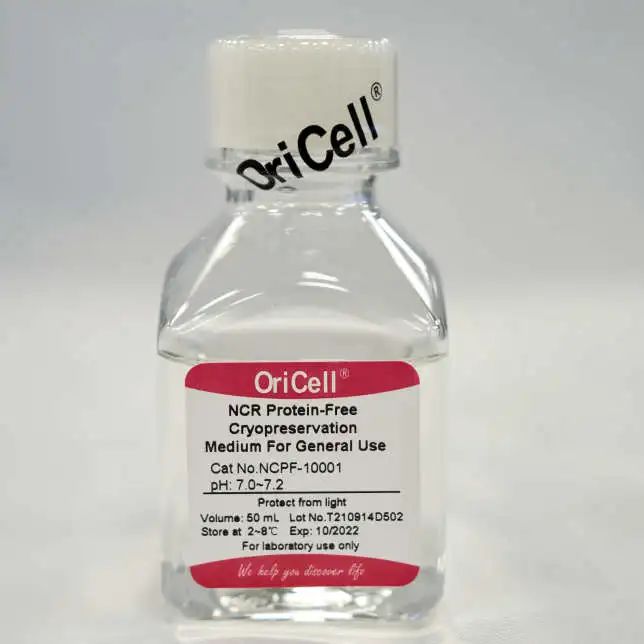
Catalog number: NCPF‑10001‑50
Related OriCell Products
- OriCell SD Rat Bone Marrow Mesenchymal Stem Cells
- OriCell C57BL/6 Mouse Embryonic Fibroblasts
- OriCell SD Fetal Rat Cortical Neurons
- Complete Medium for Rat Bone Marrow MSC
- Complete Medium for Mouse Bone Marrow MSC
- Complete Medium for Human Adipose‑derived MSC
References
[1] Pharmacopoeia of the People’s Republic of China, 2020, Part IV (Pharmaceutical excipients).
[2] Murray KA, Gibson MI. Chemical approaches to cryopreservation. Nat Rev Chem. 2022;6:579–593. https://doi.org/10.1038/s41570-022-00407-4
[3] Liu Z B, et al. Study on the Toxic and Side Effects and Application Dosage of Cryoprotectant Dimethyl Sulfoxide. Journal of the Postgraduate Medical School of the PLA. 1990(01):31–34.
[4] Awan M, Buriak I, Fleck R, Fuller B, Goltsev A, et al. Dimethyl sulfoxide: a central player since the dawn of cryobiology, is efficacy balanced by toxicity? Regen Med. 2020;15(3):1463–1491. doi:10.2217/rme-2019-0145.
[5] Willhite CC, Katz PI. Dimethyl sulfoxide. J Appl Toxicol. 1984;4(3):155–160. doi:10.1002/jat.255004.
FAQ
1. What is DMSO’s role in cell culture?
DMSO acts as a permeating cryoprotectant that reduces ice formation and osmotic shock during freezing, improving post‑thaw viability when used at appropriate concentrations (often ~10% v/v) and exposure times [2,4].
2. How can DMSO toxicity to cells be reduced?
Use the 3Rs strategy—remove residual DMSO after thaw, reduce concentration and exposure time/temperature, or replace with safer alternatives where possible [2,4].
3. DMSO vs glycerol: which cryoprotectant is better for mammalian cells?
DMSO is typically preferred for many mammalian cell types due to membrane permeability and glass‑forming properties; glycerol is commonly used for bacteria/yeast. Choice depends on cell type and protocol [2].
4. Does temperature affect DMSO toxicity?
Toxicity generally increases at higher temperatures and with longer exposure; handling at 4 °C can reduce acute toxicity compared with room temperature [3].
5. Why is 10% DMSO commonly used?
Around 10% provides a balance between cryoprotection and manageable toxicity for many cell types; exact percentages should be optimized for each cell line/tissue [2,4].
6. Should DMSO be removed immediately after thawing cells?
For most cells, immediate plating into medium followed by medium replacement after adherence, or dilution plus gentle centrifugation, effectively reduces residual DMSO without undue stress.
7. What is DMSO’s freezing point and why can cells still be frozen?
DMSO’s melting point is ~18–19 °C, but as a cryoprotectant it depresses solution freezing points and supports vitrification/controlled ice formation, enabling deep‑cold preservation [2].
8. Is DMSO suitable for bacterial cryopreservation?
DMSO can be used, but many bacterial protocols favor 10–15% glycerol. Selection depends on species and downstream needs.
9. Can DMSO interfere with downstream assays (e.g., Western blot)?
Residual DMSO can affect membranes and some readouts; thorough washing after thaw and limiting exposure helps minimize interference.
10. How do human serum albumin (HSA) or other additives affect DMSO‑containing freezing media?
Protein additives (e.g., HSA) can modulate cryoprotectant toxicity and post‑thaw recovery; always validate for your specific cell type and application [2].
About Cyagen OriCell™
Cyagen OriCell™ is a Cyagen brand focused on the research and development of cell biology products, including stem cells, primary cells, and cell lines, as well as cell culture reagents and technical services. Serving universities, research institutes, hospitals, CROs, and CDMOs worldwide, Cyagen OriCell™ has accumulated extensive expertise in cell isolation and culture. The team has developed “spatial replication” culture technology to rapidly establish growth‑supportive environments, and runs an Antibiotic‑Free process grounded in strict environmental, materials, and personnel controls. Cyagen OriCell™ provides end‑to‑end solutions—from MSC isolation and identification to directed differentiation and assay services.
Cyagen OriCell™’s offerings are cited in over 10,000 publications, with a cumulative impact factor exceeding 90,000 and more than 160,000 citations, and the team has supported more than 3,000 research groups. Products are used by tens of thousands of customers across dozens of countries and regions.

