
 EN
EN
How to Improve iPSC Recovery After Thawing: Best Practices to Help Maximize Cell Viability
Induced pluripotent stem cells (iPSCs) have become indispensable tools in regenerative medicine, disease modeling, drug discovery, and gene editing research. However, because iPSCs are highly sensitive to environmental changes, the thawing process remains one of the most critical steps affecting cell viability, pluripotency, and subsequent experimental success.
Even minor deviations during recovery—such as improper thawing, excessive centrifugation, or suboptimal culture conditions—can lead to poor cell attachment, reduced viability, or even complete culture failure.
Drawing on OriCell’s extensive experience in iPSC culture and quality control, the Cyagen team has optimized cell recovery workflows to help researchers achieve consistently high post-thaw viability. In this article, we share common pitfalls, best practices, and a standardized thawing protocol to help improve iPSC recovery rates while maintaining healthy cell morphology and stable growth.
1. Recovery Timing Directly Determines Post-Thaw Cell Condition
Mistake:
Taking more than 1 minute to transfer cells from liquid nitrogen to the water bath.
Why it matters:
Cryopreservation and recovery follow the principle of slow freezing and rapid thawing. Slow warming can promote ice crystal formation, which disrupts cellular structures and may cause irreversible cell damage. In addition, DMSO is toxic to cells at room temperature.
Best Practice:
- Remove the iPSC cryovial from the liquid nitrogen tank.
- Hold the cryovial with forceps and invert it for 2–3 seconds to allow residual liquid nitrogen in the cap to drain. This step is performed for safety reasons.
- Alternatively, the iPSC cryovial can be temporarily placed in a -80°C freezer or on dry ice to allow residual liquid nitrogen to evaporate. However, this step must not be prolonged.
- Hold the cryovial with forceps and place it in a 37°C water bath. Gently and rapidly shake the vial until only a rice-grain-sized ice crystal remains, then remove it immediately. Avoid submerging the cap below the water surface to reduce the risk of contamination.
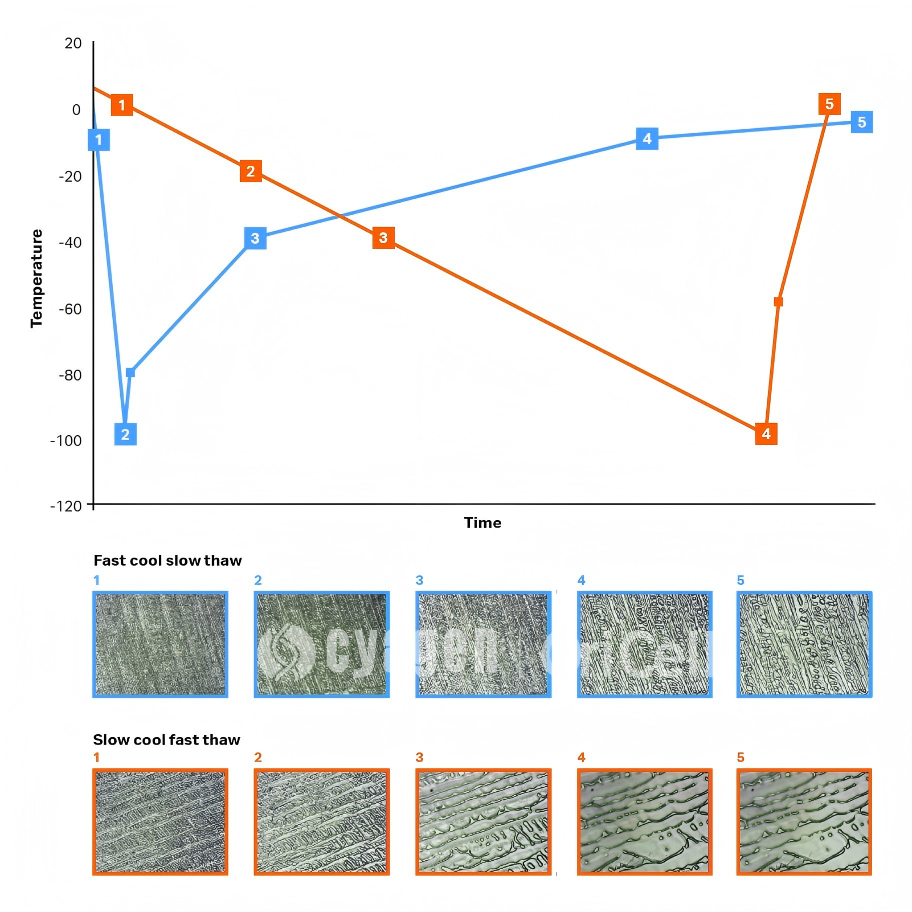
Figure 1. Ice crystal formation and state changes under slow freezing/rapid thawing versus rapid freezing/slow thawing.
2. The DMSO Detoxification Window
Mistake:
Not removing the DMSO-containing cryopreservation medium promptly after thawing.
Why it matters:
At room temperature, DMSO can rapidly induce membrane permeabilization. Exposure for more than 8 minutes may cause irreversible cell damage.
Best Practice:
This approach is particularly important for fragile clones.
- Transfer the thawed iPSC suspension into a 15 mL centrifuge tube.
- Using a pipette, add 3 mL of complete medium dropwise into the tube. After each 1 mL is added, gently swirl the tube to mix thoroughly.
- Slowly add 6 mL of complete medium, close the tube cap, and gently invert the tube to mix.
- Centrifuge at 180 × g for 5 min.
3. Cell Plating Density
Mistake:
Plating iPSCs at a conventional cell density, such as 1 × 10⁵ cells/cm².
Why it matters:
If iPSCs lack sufficient cell–cell signaling after plating, the rate of spontaneous differentiation may increase substantially.
Best Practice:
Use the following formula to calculate an appropriate plating density:
Optimal number of plated cells = (3 × 10⁴) / viability (%) × culture area (cm²)
Example:
For a 35 mm culture dish with an area of approximately 9 cm² and a viability of 80%:
Plated cell number = (3 × 10⁴ / 0.8) × 9 = 3.375 × 10⁵ cells
Therefore:
Required volume of cell suspension (μL) = plated cell number / total cell density
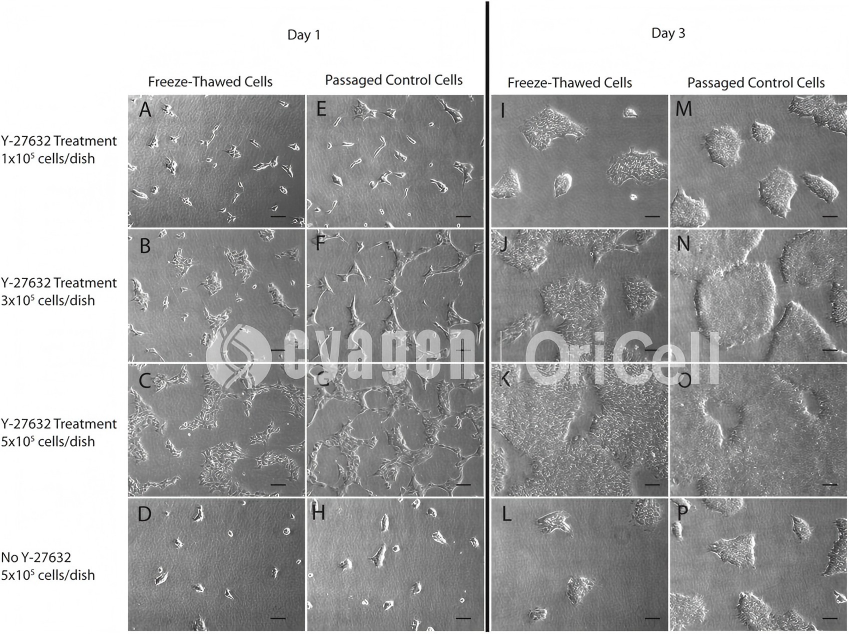
Figure 2. Colony size and density under different seeding densities.
4. Cold Stress: The Hidden Risk in Culture Medium Preparation
Mistake:
Allowing the medium to return only to room temperature and then using it directly for seeding.
Why it matters:
Freshly thawed cells are highly fragile, and the temperature of the culture medium at the time of seeding is critical.
Best Practice:
- After coating and temperature equilibration are completed, aspirate the coating solution, add iPSC complete medium, and place the plate in the incubator for at least 10 min of prewarming. This step should be completed before starting the cell thawing procedure.
- Seed the cell suspension into the medium that has already been prewarmed to 37°C.
5. Key Monitoring Indicators After Recovery
| Detection Time | Key Indicator | Acceptance Criteria | Detection Method |
|---|---|---|---|
| 24 h | Attachment rate | ≥80% | Count the cells in the supernatant to calculate the actual attachment rate. |
| 48 h | OCT4/NANOG expression rate | ≥90% | Immunofluorescence staining |
Troubleshooting FAQ
Q: What should be done if cell viability is <60% on the day of recovery?
A: Add 10 μM ROCK inhibitor (Y-27632) to the culture medium at the time of cell seeding.
Q: What should be done if spontaneous differentiation foci appear after recovery?
A: Remove the differentiated areas locally using a mechanical method.
Consistent iPSC recovery also relies on optimized culture conditions and high-quality stem cell culture media. Based on extensive stem cell research experience, OriCell provides specialized media formulated to support the maintenance and expansion of various stem cell types. Browse the OriCell Stem Cell Complete Media collection to find culture media suitable for different stem cell research applications.
About Cyagen OriCell
Cyagen OriCell is a Cyagen brand focused on the research and development of cell biology products, including stem cells, primary cells, and cell lines, as well as cell culture reagents and technical services. Serving universities, research institutes, hospitals, CROs, and CDMOs worldwide, Cyagen OriCell has accumulated extensive expertise in cell isolation and culture. The team has developed "spatial replication" culture technology to rapidly establish growth-supportive environments, and runs an Antibiotic-Free process grounded in strict environmental, materials, and personnel controls. Cyagen OriCell provides end-to-end solutions—from MSC isolation and identification to directed differentiation and assay services.
Cyagen OriCell's offerings are cited in over 10,000 publications, with a cumulative impact factor exceeding 90,000 and more than 160,000 citations, and the team has supported more than 3,000 research groups. Products are used by tens of thousands of customers across dozens of countries and regions.

