
 EN
EN
How to Isolate Bone Marrow Mesenchymal Stem Cells from Mice and Rats (Part II)
Bone marrow mesenchymal stem cells (BMSCs) can be isolated using several complementary techniques beyond standard adherence culture and bone tissue digestion. This article highlights commonly used approaches—density gradient centrifugation, immunomagnetic bead selection, and flow cytometric sorting—covering their underlying principles, typical reagents, and practical advantages and limitations.
For details on adherence-based isolation and bone tissue digestion methods, please refer to How to Isolate Bone Marrow Mesenchymal Stem Cells from Mice and Rats (Part I). You may also explore additional resources on Bone Marrow Mesenchymal Stem Cells and Cell Culture Media.
01 Density Gradient Centrifugation
Density gradient centrifugation separates bone marrow cells based on differences in their size and density. The bone marrow cell suspension is carefully layered over a density gradient medium and centrifuged, allowing various types of cells to settle at their respective isopycnic positions. Specific cell populations can then be collected from defined layers.
Commonly used gradient media include Ficoll, Ficoll-Paque, Percoll, and Lymphoprep, which are characterized by low viscosity and low osmolarity, typically used at a density of about 1.077 g/mL. During centrifugation, erythrocytes and granulocytes (density ~1.080 g/mL) sediment to the bottom. Mononuclear cells—including BMSCs, hematopoietic stem cells, and monocytes—form a gray-white interfacial layer at a density of approximately 1.056–1.075 g/mL. The plasma and dissolved components (density ~1.050 g/mL) remain on top. The grayish-white, cloudy layer above the gradient medium corresponds to the mononuclear cell fraction. After isolating this layer, adherence-based culture is performed to remove non-adherent cells (as shown in Figure 1).
Density gradient centrifugation can effectively separate BMSCs, but the process is technically demanding and difficult to perform accurately.
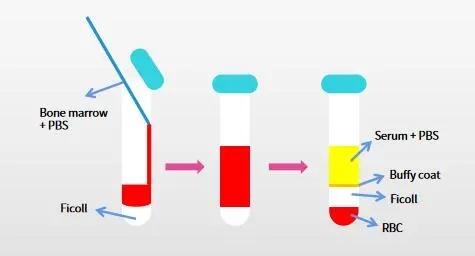
Figure 1. Density Gradient Centrifugation
Key Points
-
Advantages: This method provides effective enrichment of mononuclear cells and often enhances the initial purity of MSCs compared with direct whole marrow culture.
-
Limitations: Technique-sensitive; centrifugation and osmotic stress may compromise cell viability and functional properties.
02 Immunomagnetic Bead Selection
Immunomagnetic bead selection relies on the specific interaction between cell surface antigens and monoclonal antibodies conjugated to magnetic beads. Under the influence of an external magnetic field, cells bound to antibody-labeled beads are retained within the magnetic field, while cells lacking the target surface antigen remain unbound and pass through, thereby enabling efficient separation of desired cell populations.
This technique can be performed using either positive or negative selection. In positive selection, the bead-bound cells are the target cells to be collected. In negative selection, unwanted cells are are labeled and removed, so that the target cells remain in the supernatant.
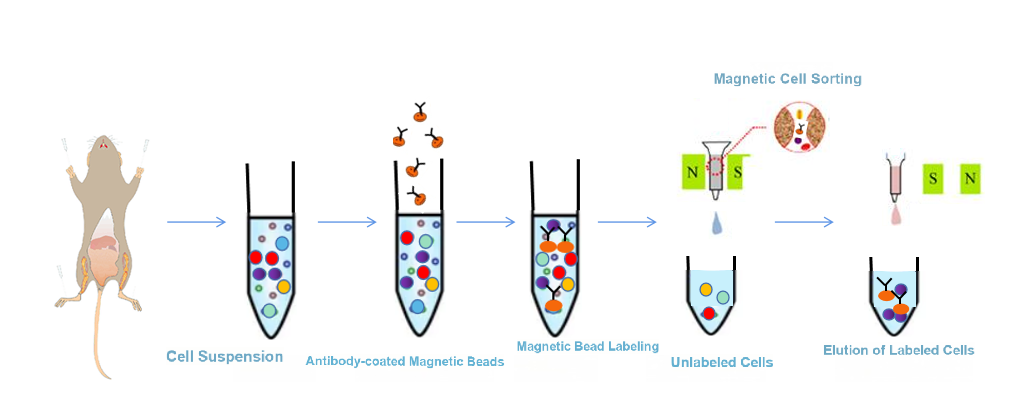
Figure 2. Immunomagnetic Bead Selection
Since BMSCs currently lack a unique surface antigen, positive selection is not feasible. Therefore, CD11b-based negative selection is commonly used. CD11b is regarded as a granulocyte-specific marker, but it is also abundantly expressed on macrophages and at similar levels to granulocytes. Given that nucleated non-stromal cells in the bone marrow primarily include neutrophils, monocytes, and macrophages, CD11b-negative selection can efficiently remove these contaminating cell populations to facilitate the isolation of target BMSCs.
Immunomagnetic bead separation is a simple and efficient isolation method requiring only a magnetic separator, with no need for additional specialized equipment. This approach enables high-throughput isolation of BMSCs.
Key Points
-
Advantages: Simple, efficient, and high-throughput, requiring only minimal equipment (magnetic rack).
-
Limitations: Cost of antibodies and beads; handling may affect cell proliferation; basic setups allow only limited simultaneous antigen selection.
03 Flow Cytometric Sorting
The principle of flow cytometric sorting (FACS) is as follows: a single-cell suspension, stained or labeled with fluorescent markers, is introduced into a sample tube and then pushed at high pressure into the flow chamber. The chamber is filled with sheath fluid that surrounds and propels the cells, aligning them into a single-file stream that exits the nozzle at a controlled speed.
At the nozzle, an ultrahigh-frequency piezoelectric crystal vibrates when charged, breaking the stream into uniform droplets, with individual cells dispersed within these droplets. The droplets are electrically charged with positive or negative polarity. As the charged droplets pass through a high-voltage deflection plate, they are deflected by the electric field and collected into designated containers. Droplets without charge are directed into a waste container. This process allows precise sorting and separation of cells.
This method requires operation with a flow cytometer, including instrument parameter adjustments, and is technically demanding. In addition, it imposes significant stress on the cells and carries a higher risk of contamination.
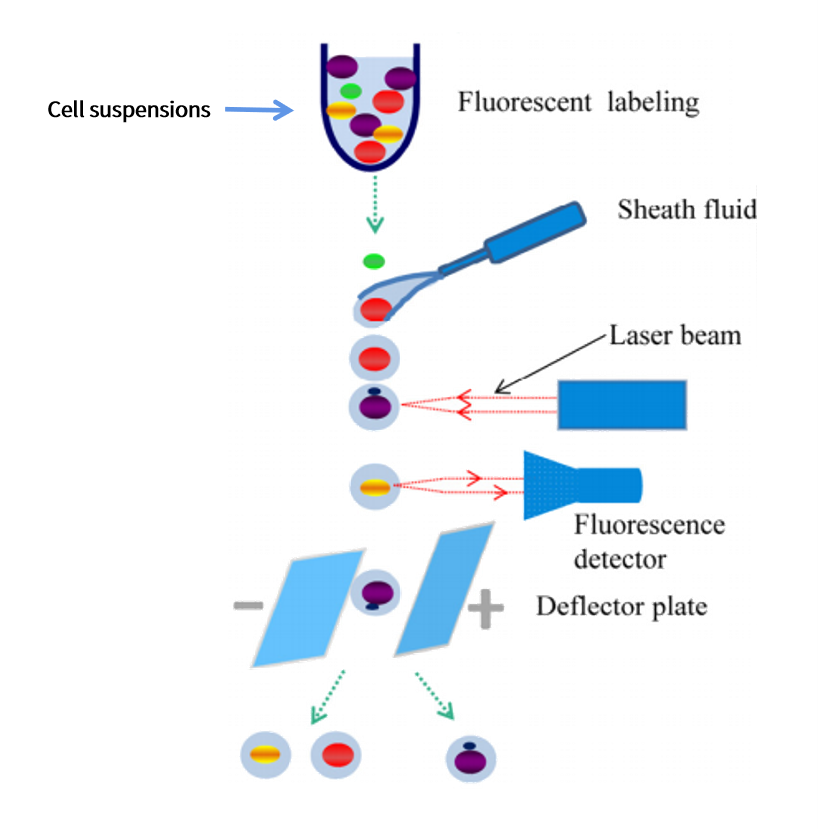
Figure 3. Flow Cytometric Sorting
Key Points
-
Advantages: Achieves the highest purity; multi-parameter discrimination allows gating by multiple markers.
-
Limitations: Requires specialized instrumentation and technical expertise; sorting stress may reduce cell viability; limited throughput and longer sorting times.
Summary of Pros and Cons
| Isolation Method | Advantages | Limitations |
|---|---|---|
| Adherence Selection | Simple, quick setup; lower contamination risk; fast growth | Lower initial purity |
| Bone Tissue Digestion | Simple, low cost; higher purity vs adherence | Collagenase II digestion can affect cell viability and proliferation |
| Density Gradient Centrifugation | Higher purity vs adherence; enriches mononuclear cells | Technique-sensitive; potential reduced viability/function |
| Immunomagnetic Bead Selection | High purity, high throughput | Cost; potential proliferation impact; limited simultaneous antigen selection |
| Flow Cytometric Sorting | Highest purity; multi-marker discrimination | Technical-demanding; instrument cost; lower throughput; potential stress |
OriCell™ BMSC Products & Media
OriCell™ provides bone marrow mesenchymal stem cell products across species, with customized complete culture media and differentiation/induction media tailored to each MSC type. See Bone Marrow Mesenchymal Stem Cells and Cell Culture Media. If you would like to know more about our products, please feel free to contact us.
- Email: [email protected]
- Tel: +86-20-31601002-8039
- Address: No. 19, Dongcang South Road, Taicang, Suzhou, Jiangsu, 215400 China
Related Q&A
1. What gradient medium and density are typically used for mouse/rat bone marrow?
Ficoll-Paque or similar media at ~1.077 g/mL are commonly used. Collect the mononuclear layer at the interface, then use adherence culture to enrich MSCs.
2. Does density gradient centrifugation affect BMSC viability or function?
Yes. Centrifugation stress and osmotic fluctuations may decrease cell viability and affect functional properties. Gentle handling and minimizing exposure time can help preserve cell integrity.
3. Can BMSCs be positively selected with magnetic beads?
Universal positive selection is not feasible because BMSCs currently lack a unique surface antigen. Therefore negative selection (e.g., CD11b depletion) is often used to remove granulocytes, monocytes and macrophages.
4. What markers distinguish mouse BMSCs from hematopoietic cells?
Mouse BMSCs are typically positive for CD29, CD44, Sca-1, and CD90, and negative for CD45, CD11b, and CD34. In contrast, hematopoietic cells are usually CD45⁺/CD11b⁺ and non-adherent.
5. How often should the medium be changed for BMSC culture?
No. After the initial removal of non-adherent cells (within 24–48 hours), medium replacement every approximately 3 days is standard. The schedule may be adjusted based on cell density and nutrient depletion.
6. What medium is recommended for BMSC culture?
A complete MSC-supportive medium is recommended, generally consisting of a basal medium supplemented with fetal bovine serum (FBS). See Cell Culture Media.
7. Which collagenase should be used for digesting bone chips, I or II?
Collagenase II (~1 mg/mL) is most commonly used. Optimize enzyme type, concentration, and digestion time to achieve a balance between cell yield and viability.
8. How do BMSCs differ from bone marrow-derived macrophages (BMDMs)?
BMSCs are adherent, spindle-shaped, and negative for CD45/CD11b, whereas BMDMs are generated with M-CSF, express CD11b, and display typical macrophage morphology and phagocytic activity.
9. Can FACS sort cells based on multiple markers to enrich MSCs?
Yes. FACS allows multiparametric gating based on several markers simultaneously. However, sorting stress and throughput limitations should be considered when planning experiments.
10. What are best practices to minimize contamination across procedures?
Use strict aseptic techniques, thoroughly remove residual tissue, include antibiotics during washing steps when appropriate (but not as substitutes for sterility), and promptly discard non-adherent cells to reduce contamination risk.
About Cyagen OriCell™
Cyagen OriCell™ is a Cyagen brand focused on the research and development of cell biology products, including stem cells, primary cells, and cell lines, as well as cell culture reagents and technical services. Serving universities, research institutes, hospitals, CROs, and CDMOs worldwide, Cyagen OriCell™ has accumulated extensive expertise in cell isolation and culture. The team has developed “spatial replication” culture technology to rapidly establish growth‑supportive environments, and runs an Antibiotic‑Free process grounded in strict environmental, materials, and personnel controls. Cyagen OriCell™ provides end‑to‑end solutions—from MSC isolation and identification to directed differentiation and assay services.
Cyagen OriCell™’s offerings are cited in over 10,000 publications, with a cumulative impact factor exceeding 90,000 and more than 160,000 citations, and the team has supported more than 3,000 research groups. Products are used by tens of thousands of customers across dozens of countries and regions.

