
 EN
EN
How to Isolate Bone Marrow Mesenchymal Stem Cells from Mice and Rats (Part I)
Bone marrow mesenchymal stem cells (BMSCs) are multipotent stromal cells widely used in research. Variations in isolation and culture methods can significantly affect their purity, viability, phenotype, and differentiation potential. For more details, see our overview of BMSCs and OriCell™ reagents, including fetal bovine serum (FBS) and specialized cell culture media.
01 Adherence Selection (Whole Bone Marrow Direct Culture)
The adherence-based selection method takes advantage of differences in cell adhesion time and adhesion strength to gradually remove non-adherent cells and other contaminating cells. It is a simple and convenient method commonly used in stem cell culture and is therefore the most widely applied approach for isolating BMSCs.
By exploiting the adherent growth characteristics of BMSCs, floating hematopoietic cells can be gradually removed by changing the culture medium, resulting in a relatively purified BMSC population. In addition, hematopoietic stem cells in the bone marrow secrete growth factors and adhesion-promoting substances, which can enhance BMSC adhesion and growth. For this reason, the adherence-based selection method is also often referred to as the direct culture method or the whole bone marrow method.
Materials
- C57BL/6J mice (3–4 weeks, SPF) or SD/Wistar rats
- 75% ethanol
- Sterile phosphate-buffered saline solution (PBS) with penicillin-streptomycin solution
- Complete culture medium (use 20% FBS for initial plating)
- CO2 incubator (37°C, 5% CO2, saturated humidity)
Procedure
-
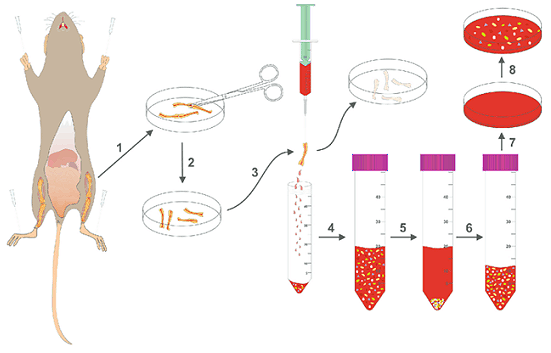
Euthanize the mouse or rat by cervical dislocation following approved protocols, and immerse the carcass in 75% ethanol.
-
Under aseptic conditions, expose the hindlimbs and dissect out the bilateral femurs and tibias. Place the bones in sterile PBS containing antibiotics.
-
Carefully remove surrounding muscle and connective tissue, then rinse the bones three times with PBS containing antibiotics.
-
Trim both ends of each femur and tibia with sterile micro-scissors to expose the marrow cavity.
-
Flush the marrow cavities repeatedly using a syringe filled with complete medium until the bones appear pale or white.
-
Collect the bone marrow effluent, centrifuge to pellet the cells, resuspend in appropriate complete medium containing 20% FBS, and seed into culture dishes.
-
Incubate at 37°C with 5% CO₂. After 24–48 hours, gently remove non-adherent cells.
-
Change the medium every 3 days thereafter until the cells are ready for passage.
Notes
- Adherence selection is straightforward and relatively low risk for contamination—ideal for beginners.
- Main limitation: lower purity at early stages due to co-isolated hematopoietic cells.
02 Bone Tissue Digestion (Bone Chip Method)
Bone tissue digestion is simple and cost-effective, and often yields higher purity than adherence selection.
Materials
- Bones prepared as above (femurs/tibias after marrow flushing)
- Collagenase Type II (final concentration ~1 mg/mL)
- Complete culture medium (5% FBS for digestion; 20% FBS for culture)
Procedure
-
Following steps 1–3 above, collect the femurs and tibias after marrow flushing into a sterile dish. Carefully mince the bones into ~1–3 mm³ chips.
-
Add fresh complete medium containing 1 mg/mL Collagenase II and 5% FBS, and gently agitate on a 37°C shaker/incubator to digest the bone chips.
-
After digestion, centrifuge and discard the supernatant. Wash the bone chips twice with PBS, then seed them into culture dishes. Add sufficient complete medium containing 20% FBS to fully cover the bone chips, and incubate at 37°C in 5% CO₂.
-
Perform the first half-medium change after 72 hours. Thereafter, change the medium every 3 days.
-
When adherent cells reach 80–90% confluence, proceed to expansion and passaging.
Notes
- Digestion with Collagenase II digestion can affect the viability and proliferative capacity of bone marrow–derived mesenchymal stem cells (BMSCs). It is recommended to optimize both the digestion duration and enzyme concentration to maximize cell yield while maintaining cell viability.
- We will introduce density gradient centrifugation, flow cytometric sorting, and magnetic bead selection in Part II. For more product information and technical support, please feel free to contact us.
Related Q&A
1. What are BMSCs?
Bone marrow mesenchymal stem cells (BMSCs) are multipotent stromal cells capable of self-renewal and differentiation into osteogenic, chondrogenic, and adipogenic lineages. In mice, typical positive markers include CD29, CD44, Sca-1, and CD90, while negative markers include CD45, CD11b, and CD34.
2. Do BMSCs adhere to plastic?
Yes. BMSCs are adherent cells and can be enriched by removing non-adherent hematopoietic cells during the early stages of culture.
3. How do I isolate mouse BMSCs by adherence selection?
Flush the femur and tibia marrow with complete medium, seed the cells into culture dishes, remove non-adherent cells after 24–48 hours, and replace the medium every 3 days until the cells reach confluence.
4. What medium should I use for BMSCs?
Use a complete medium suitable for MSCs. Many protocols employ a basal medium supplemented with FBS. OriCell™ provides both complete and serum-free media specifically designed for various MSC types—see Cell Culture Media for details.
5. What is the bone chip (bone tissue digestion) method?
After removing the marrow, mince the bones into small chips (~1–3 mm³) and digest with Collagenase II (~1 mg/mL) at 37°C. Seed the bone chips and allow adherent MSCs to grow out.
6. Does Collagenase II impact BMSC viability?
Over-digestion can reduce cell viability and proliferation. Optimize enzyme concentration and digestion duration to balance cell yield, purity, and health.
7. How do I distinguish BMSCs from hematopoietic cells?
Assess morphology, adherence, and immunophenotype. BMSCs are spindle-shaped, adherent, and negative for hematopoietic markers (e.g., CD45), whereas hematopoietic cells are non-adherent and marker-positive.
8. Are mouse and rat BMSCs handled differently?
Core principles are similar, but strain, age, and tissue differences can affect yield and growth. Optimize protocol parameters accordingly.
9. Do I need M-CSF to isolate BMSCs?
No. M-CSF is primarily used for macrophage derivation (e.g., bone marrow-derived macrophages). BMSC isolation relies on adherence and/or tissue digestion, not M-CSF supplementation.
10. Best practices to minimize contamination?
Use strict aseptic techniques, thoroughly remove muscle and connective tissue, include antibiotics in PBS rinses (but do not rely on them as a substitute for sterility), and promptly remove non-adherent cells during early culture.
About Cyagen OriCell™
Cyagen OriCell™ is a Cyagen brand focused on the research and development of cell biology products, including stem cells, primary cells, and cell lines, as well as cell culture reagents and technical services. Serving universities, research institutes, hospitals, CROs, and CDMOs worldwide, Cyagen OriCell™ has accumulated extensive expertise in cell isolation and culture. The team has developed “spatial replication” culture technology to rapidly establish growth‑supportive environments, and runs an Antibiotic‑Free process grounded in strict environmental, materials, and personnel controls. Cyagen OriCell™ provides end‑to‑end solutions—from MSC isolation and identification to directed differentiation and assay services.
Cyagen OriCell™’s offerings are cited in over 10,000 publications, with a cumulative impact factor exceeding 90,000 and more than 160,000 citations, and the team has supported more than 3,000 research groups. Products are used by tens of thousands of customers across dozens of countries and regions.

