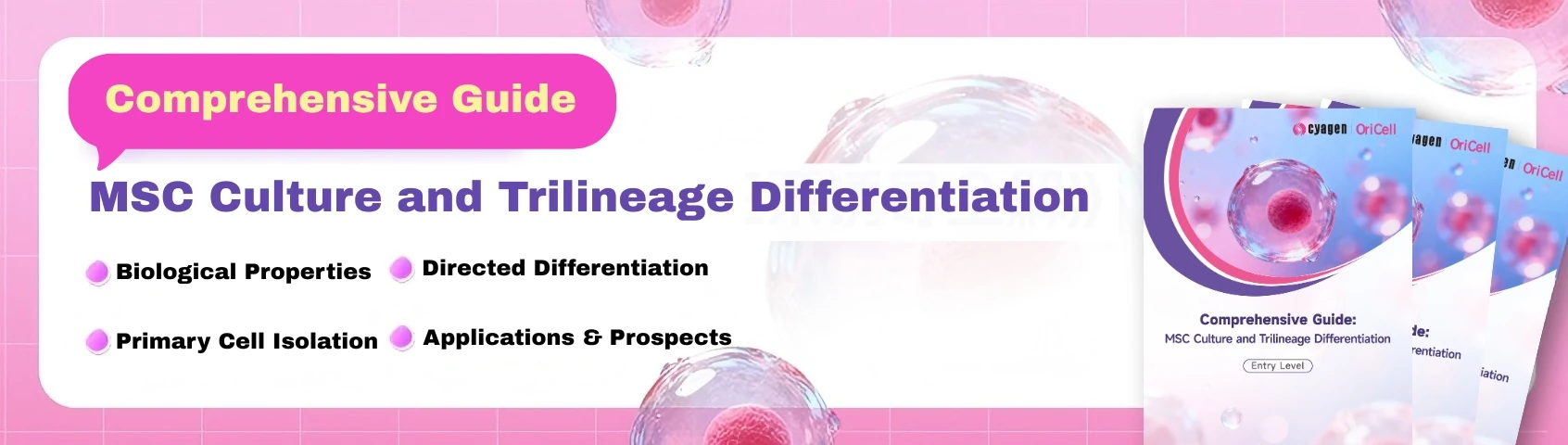
Preface
The application boundaries of Mesenchymal Stem Cells (MSCs) are constantly expanding, becoming a key bridge connecting basic research and clinical translation. However, for research beginners, issues such as basic culture during MSC cultivation and efficiency control of trilineage differentiation induction are often "roadblocks" hindering research progress. Mastering standardized and efficient technical methods has become the core prerequisite for starting MSC research.
Based on nearly 20 years of stem cell research experience, Cyagen OriCellTM has compiled the "Comprehensive Guide:MSC Culture and Trilineage Differentiation" research starter guide. Whether you are a student just starting MSC research or a research team needing to optimize experimental protocols, this guide can provide you with practical technical support.
What can you learn from this PDF?
Systematic MSC knowledge framework: From definition and characteristics of different sources to biological functions, helping you quickly establish basic cognition and clarify core research directions.
Standardized practical procedures: Detailed breakdown of key operations such as cell passage digestion time, freezing points, and recovery plating density, paired with steps and identification methods for trilineage differentiation induction (osteogenic/adipogenic/chondrogenic), directly benchmarking experimental operations.
Practical problem solutions: In-depth analysis of influencing factors such as serum quality and culture temperature, providing verified optimization strategies to avoid common experimental "pitfalls".
Guidebook Catalog Summary
I. Introduction to MSCs: Definition, Sources, Biological Characteristics, and Application Prospects in Medicine
II. MSC Culture Workflow
1. Preparation before culture
2. Cell Thawing
3. Cell Passaging
4. Cell Cryopreservation
5. Quality Control during Culture
III. MSC Trilineage Induction
1. Osteogenic Induction
2. Adipogenic Induction
3. Chondrogenic Induction
IV. Influencing Factors and Optimization Strategies for MSC Culture and Induction
1. Basic Culture: Core Factors Influencing Downstream Experiments
2. Common Influencing Factors and Optimization Strategies for Trilineage Induction
V. Application Prospects and Outlook
FAQ on MSC Culture and Induction
1. What is the passaging ratio for MSCs?
Choose an appropriate density for passaging. Generally, a 1:3 ratio is recommended. Cells should grow to passagable confluence within 72h. To ensure post-passage growth, please adjust the ratio based on actual cell growth.
2. How to determine if MSC osteogenic induction is ready for Alizarin Red staining?
Do not decide staining time based on induction duration; ensure calcium nodules are visible under the microscope.
3. How to use the Adipogenic Induction Kit?
In the early stage, follow the "3 days Solution A, 1 day Solution B" cycle. In the later stage, switch to Solution B for maintenance.
4. How to prepare Oil Red O staining solution for adipogenic differentiation?
Mix OriCellTM Oil Red O Stock Solution : Distilled Water = 3:2. Mix well, centrifuge at 250×g for 4 minutes, and use the supernatant; or filter after mixing.
5. Is pellet culture necessary for chondrogenic induction? Can 2D plates be used?
Not necessary, choose according to experimental requirements. OriCellTM Chondrogenic Induction Kit can be used for both pellet and planar induction, though pellet culture yields better results.
6. Why is my cell induction differentiation failing? How to select MSC status?
Try to use cells with low passage number, good status, and high viability to improve induction success rate.
Q&A on MSC Trilineage Differentiation
Q1. What is MSC trilineage differentiation?
MSC trilineage differentiation refers to the ability of Mesenchymal Stem Cells to differentiate into three specific lineages: osteoblasts (bone), adipocytes (fat), and chondrocytes (cartilage) under specific induction conditions.
Q2. How can I detect osteogenic differentiation in MSCs?
Osteogenic differentiation is typically detected using Alkaline Phosphatase (ALP) staining (early marker) and Alizarin Red S staining (late marker for calcium deposits).
Q3. What is the best method to identify adipogenic differentiation?
Adipogenic differentiation is commonly identified by Oil Red O staining, which stains the lipid droplets accumulated in the differentiated cells red.
Q4. Is pellet culture required for chondrogenic differentiation?
While 2D culture is possible, 3D pellet culture is highly recommended for chondrogenic differentiation as it better mimics the in vivo cartilage environment and improves differentiation efficiency.
Q5. What are the key factors affecting MSC differentiation efficiency?
Key factors include cell passage number (lower is better), cell health/status, confluence at induction, and the quality of the induction media.
Q6. Can MSCs differentiate into fibroblasts?
MSCs and fibroblasts share some similarities, but they are distinct. MSCs have multipotent differentiation potential (trilineage), whereas fibroblasts generally do not.
Q7. What is the typical protocol for MSC osteogenic induction?
The protocol generally involves seeding cells, waiting for confluence (60-80%), and then replacing the growth medium with osteogenic induction medium, changing it every 2-3 days for 2-4 weeks.
Q8. Why does my osteogenic induction fail (no calcium nodules)?
Failure can be due to high cell passage, poor cell condition, improper cell density, or expired induction reagents. Ensure you use early-passage MSCs.
Q9. Where can I find reliable MSC differentiation kits?
Cyagen OriCellTM offers comprehensive differentiation kits for osteogenesis, adipogenesis, and chondrogenesis, optimized for various species.
Q10. How do I verify MSC identity before differentiation?
MSC identity is verified by surface marker expression (positive for CD73, CD90, CD105; negative for CD34, CD45, etc.) and their trilineage differentiation potential.

 EN
EN